Showing posts with label Frances Watthanaya. Show all posts

Sunday, September 6, 2015

Muay Thai Gambling in Thailand 101 - Part Two Ringside Betting

Written by Frances Watthanaya

There are three ways to gamble on fights in Thailand: 


The Side Bet (Part one of this article)

Ringside Betting

Underground Betting


Ringside Betting
One of my friends from Bangkok, a stadium regular at Rajadamnern, recently came to visit me in Isaan. We decided to get him a fight in Isaan, hoping that we would clean up on the side bet, as well as general ringside betting. While an overwhelming majority of Thai fighters make their start in Isaan, my friend had started in the capital. It was easy to assume that back here in Isaan, he would be unknown as a fighter. 

Photo by Lindsey Newhall
While warming up in Mahasarkham Province, a seven-hour drive from Bangkok, a local gambler who frequented Rajadamnern quickly recognized my friend. He approached us, asking to get in on his side bet. News quickly spread and by the time my friend got in the ring, he was already favoured to win.

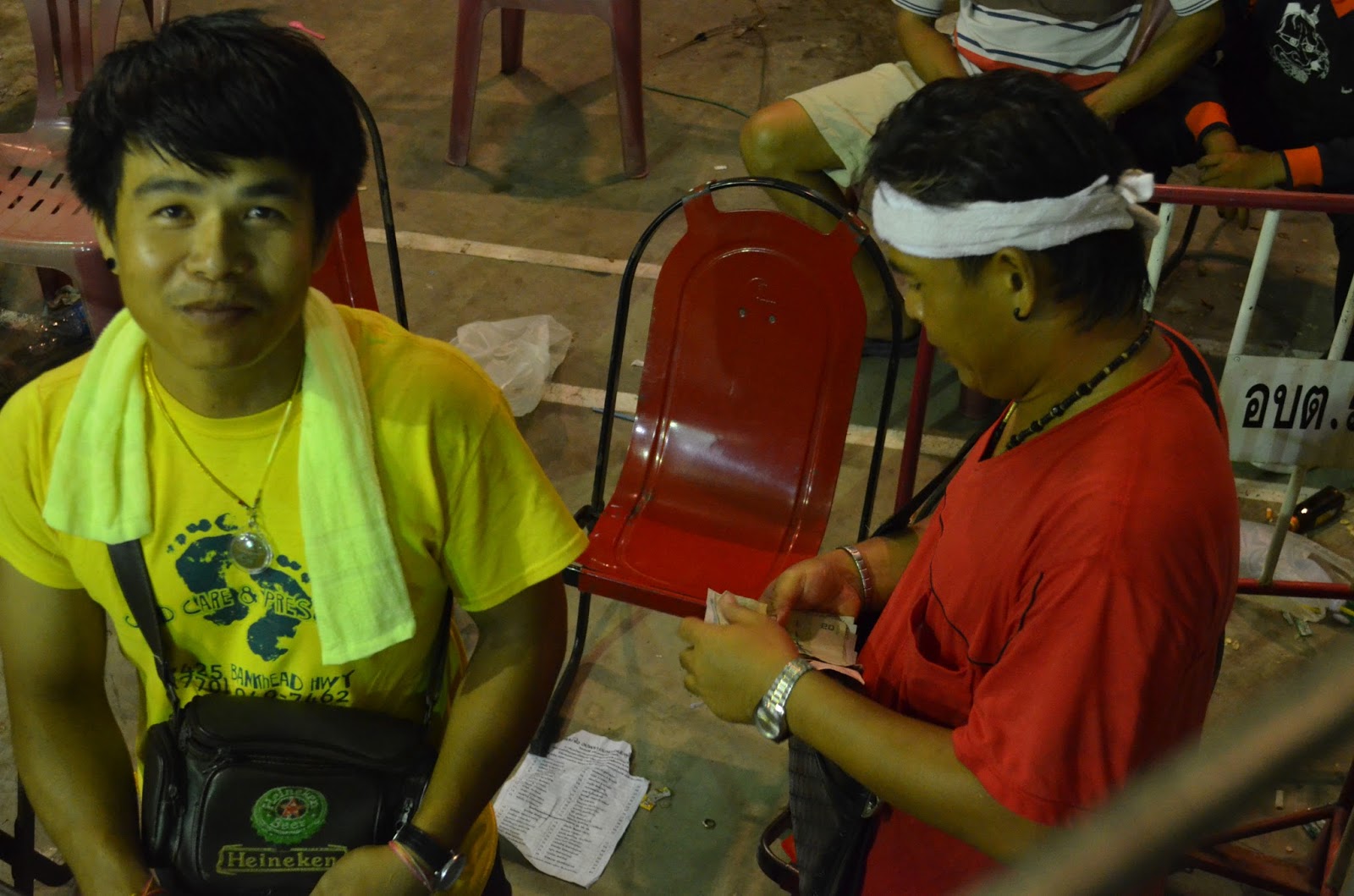
All Muay Thai fights in Thailand have ringside betting. It is a common joke in Thailand that no one actually goes to watch Muay Thai for fun; rather, they are just there to gamble. Ringside betting is the most complicated aspect of Muay Thai gambling. People who participate are professionals many of whom use gambling as a full-time job, travelling across the country to partake in this dicey lifestyle. 

Although gambling is technically illegal in Thailand, permits are acquired beforehand, thus rendering gambling at the stadium or outdoor fights legal. Bets are placed both directly before and during the fights. It is common for gamblers to place multiple bets on a single fight as the odds are constantly changing. It is even possible for highly skilled gamblers to place multiple bets in such a way that they can come out ahead regardless of who the victor is.

Bets are arranged through a series of hand signals. Thumbs-up means that you're betting for the red corner to win, whereas a pinky finger indicates you favour the blue. From there odds will be placed, three fingers up means that you want to take the favourite with 3-2 odds. In this situation you will bet 300 but will only win 200. If you show three fingers facing down, it indicates you want to bet on the underdog. Putting down 200 will get you 300 if your fighter can pull through. You can bet any amount. At the big stadia in Bangkok, gamblers will put down thousands of baht, whereas in the countryside, the bets are commonly smaller. 

At large stadia in Bangkok, gamblers are blocked off in sections and the use of laser pointers or ladders is not permitted, thus they are limited to placing bets with those only in their immediate section. Outside the capital, gamblers often bring laser pointers and rent ladders at the venue. From there, they are able to places bets with anyone around the venue. If you see a laser pointer being shined at a fighter, it means he is being offered a tip to win the fight.

Photo by Lindsey Newhall


Odds are called by someone known as the “big legs.” These guys are known throughout the gambling communities, having earned their spot by being able to place very large bets. In extremely close fights, fighters who have the “biggest legs” in their corner will be awarded the win. This type of decision reflects one of the negative aspects of the sport, how power and money can influence the outcome of big match-ups. 
Gamblers know each other, and the chances of someone running out on a bet are extremely rare. Instead, poisonings or a fighter throwing a fight remain the highest risks for gamblers. Occasionally in both situations, if it is obvious what has happened, the referee will declare a no-contest. 

Read PART ONE of Muay Thai Gambling in Thailand 101
Sunday, June 21, 2015

Muay Thai Gambling in Thailand 101 - Part One

Gambling in Thailand 101 - Part One
Written by Frances Watthanaya
 
There are three ways to gamble on fights in Thailand:

The Side Bet
Ringside Betting
Underground Betting
 
The Side Bet
 
The side bet is held at ringside and collected prior to the fight. There are no odds and the winner takes all. There are four types of side bets:

The most common side bet is one collected directly prior to the fight. Two or three fights before, the ring announcer will call for one’s side bet; money is collected on the spot and will be adjusted until it is even on both sides.
 
For bigger fights camps will agree with the promoter on the amount ahead of the time. This amount must be matched the night of the fight or the fight is off. Side bets like these range from $600USD to $60,000USD.

Deposited side bets are occasionally implemented. The morning of the fight, the promoter will require a deposit for each match-up equal to half the amount of the minimum side bet. The idea behind this is so fighters don’t just show up at the match-ups wanting to fight solely for their purse, but must be honest in their pursuit. In cases like this the minimal amount a fighter must bet is $30USD, if they cannot match this amount their $15USD deposit is forfeited and they don’t get to fight.

The fake side is very common in Thailand, and often very easy to spot. Fake side bets usually take place under two sets of circumstances. The first is for new and unknown fighters who want to show promoters that they have a side bet, but in actuality they can’t afford one and aren’t confident in their fighters. This is discussed privately by gyms ahead of time. Money is still placed at ringside and the winner will still take it all, but afterwards it is divided back between the two camps. This is often the case when deposited side bets are forced. The other fake side bet happens when two, big named fighters are mismatched based on weight. Promoters will use their names as a draw to get people to come watch the fights, and the fighters will come to collect their purse. The side bet is all for face; this is only done on small shows like at temple fairs.

Fights without a side bet aren’t considered competitive, and not having a side bet is a form of losing face in Thailand. There is opportunity though, at temple fairs for young fighters to get their start without the pressures of gambling.
 
Check out my Part Two on ringside betting next month!

Thursday, April 9, 2015

Chanticleer and the Pugilist

Written by Frances Watthanaya
Photos by Robert P. Cohen 

 
I have yet to be to a Muay Thai gym, outside of Bangkok, that wasn’t raising and subsequently fighting cockerels. Even atop a mountain, at Kem Muay Thai Gym in Kao Yai, there were cockerels. 
Photo by Robert P. Cohen
The drive took us three hours from where I live in Buriram Province. It was another hour from Khorat City, and about 20 minutes winding up a partially paved mountain trail, no wider than my Toyota Yaris. I noticed the chickens before I noticed the fighters. Their cages were like nothing I had seen before - similar in design to what I am accustomed to in Isaan, but nicer. Made of wire, as opposed to short lived bamboo, they were more ergonomic and without a doubt more expensive.
 
Photo by Robert P. Cohen
Kem arrived shortly after we had settled ourselves in. 
“Is there a lot of opportunity to fight up here,” I ask.

“It isn’t like Isaan, if that’s what you mean. We mainly take our fighters to fight in Bangkok. I don’t have the time to take them to fight locally; events are few and far in-between. We train a few kids, but their parents are the ones that take them to fight.”

“What about your chickens?”

Kem started laughing,

“Oh, they get fights. There are lots of local shows for cock fighting even up here.” 
Photo by Robert P. Cohen
In fact, one could argue that cock fighting is more prominent in Thai culture than Muay Thai. It is a custom and tradition that goes back to the first ever Thai Kingdom of Sukhothai and increased in prominence during the Ayutthaya period when it became a Royal custom. With such deep roots in Thai history, cock fighting has established itself as an integral part of Thai society.
 
Despite having lived in Thailand on and off for nearly 10 years, I didn’t see my first cock fight until earlier this year when friend and photographer Robert P. Cohen was visiting and asked that I take him. In the villages fights take place at local hot spots; bets are placed and police look the other way. Small shows likes these rarely gather crowds of more than 20 or so people, and the competing cockerels are usually from neighbouring villages. Bigger shows with larger bets will require a gambling permit. In Prakhon Chai, Buriram Province, there is a permanent cock fighting stadium equipped with seating for 500, warm up rings, washrooms, and lighting. Even now, there is still no permanent Muay Thai stadium in Isaan, despite the overwhelming majority of all fighters coming from this region. 
Photo by Robert P. Cohen

People often compare raising gamecocks to Muay Thai fighters; you see the cockerels training, getting massages, and put on a strict sleeping and eating schedule just like fighters. But what happens in a fight and during the life cycle of cockerels differs drastically to Thai boxers.
  • Cockerels are stitched up in-between rounds, whereas Muay Thai fighters must wait until after the fight.
Photo by Robert P. Cohen


  • Blood is wiped from a fighters face with some sort of cloth, whereas blood is sucked from the cockerels face with one’s own mouth. [Yes, this is true.]
  • Muay Thai is five rounds of three minutes, whereas cockerels fight five to six twenty minute rounds.
Photo by Robert P. Cohen

  • Cockerels will fight no more than once a month and will be given adequate time to heal after fights. Muay Thai fighters often fight up to eight times per month and will more often than not will be fighting with an injury.
  • Cockerels will only fight for a few years, and will be retired after a few bad performances. Fighters can have careers spanning up to 20 years and can amass three hundred plus fights during that time. 
Photo by Robert P. Cohen
Robert P Cohen, originally from New York, is a photographer currently based in South East Asia. His current body of work is his Little Tigers Series that focuses on the young child fighters of Thailand. You can find Robert on Twitter, Instagram, and Tumblr. Check out his website here. 

Wednesday, January 28, 2015

Boon-Rot: What's In a Fighter's Name

By Frances Watthanaya

We had five fighters up from the gym, three of whom had already fought. I only just arrived at 5pm but everyone else had been there since morning. The fights started at 11am, and showed no signs of ending quickly. This was going to be a long day, typical of temples fights in Isan. I look over the program and can't find Lai on the list. I walk over to where he is sitting, taking refuge from the sun he had found a flat patch of dirt underneath a large tree. He didn’t smell of Thai Boxing liniment, so I knew he was one of the ones who hadn’t fought yet.

Photos by Scott Hirano
He has been my favourite fighter at the gym for a while now. I’m able to make a lot of money off of him, and he appreciates the tips. He is the only fighter at the gym with nowhere else to go. His dad dropped him off a year ago; we haven’t seen his father since.

Lai sees me holding the program. He looks straight down to the dirt ground and I quickly am reminded of the fact he can’t read.

“Who is this? Pet-Satuek Giatbundit Gym เพชรสตึก เกียรติบัณฑิตยิมส์,” I ask him.

“Me, Dad changed my name” he responds, relieved I can read a bit of Thai.

Dit is the owner and head trainer at the gym, to the fighters he is known as Dad. Lai’s family comes from Satuek Distrct in Buriram Province; one of the poorest areas in Thailand. The 'Pet' in Lai's fight name, Pet-Satuek, translates as 'diamond,' thus Lai is ‘The Diamond of Satuek’. Localized names likes these are very common through out Isan but rarely last in Bangkok. If the fighters make it to the bigger stadia they are given names that are more identifiable to a national audience.

Thai parents give their children powerful names at birth, though these names are rarely used in a person's daily life. At birth relatives will also bestow the child with a nickname, often characteristic of their appearance or delivery story. A child born in a rainstorm will be known as Fon (rain), or a child with dark skin will be called Dam (black). These names stick for life.

Fight names, however, are much different. Fighters will often cycle through names, determining which name sees them through the most success. Usually bestowed by managers, elder family members, or trainers, fight names often change in the natural course of a fighter's competitive life, for example, when fighters move gyms, are stuck in a losing streak, or become markedly more successful.
Fight names have always been of interest to me. There are so many layers of meaning and interpretations. Learning a fighter’s name is like learning a secret about them. The complexity of the name can show their value at the gym.

Lai was no exception to this, he had fought under more names than he could remember. One that he did remember, though was Tuung-Ngen ถุงเงิน. It was given to him by his grandfather and means bag of money. He had a lot of victories under that name, but during a down swing he was re-christened Lek-Lai เหล็กไหล again by a family member, most likely his mafia uncle. Lek-Lai is a magical, yet mysterious substance that is believed to be indestructible and immortal. The name fit for Lai; there were so many layers to him that he kept hidden and despite being abandoned repeatedly, he still was alive.

The name saw him through typical ups and downs of a fifteen-year-old fighter but Lai was not managed well, nor was he taken care of at the gym. Most of the local fighters were subsidized both emotionally and financially by their families. Lai was left largely to fend for himself until I arrived at the gym.

Over time Lai became my responsibility. Before big fights he would come live with us so that his training and nutrition could be properly monitored. I realized quickly that this would be a long-term relationship and asked Dit to sign him over officially to me. The gym laughed at me, told me there were better fighters and that he wouldn’t amount to anything. They laughed at Lai too; the kid who can’t read is going to be adopted by a foreigner?

But I persisted and Lai became my fighter. I gave him the name Boon-Rot บุญรอด, which means one that has escaped death through virtue of their own self. Everyone at the gym applauded the name. Dit even said he could imagine it on Channel 7. Thus far, Lai has remained undefeated under his new name. When he hears it over the loudspeaker at fights, I can see a sense of pride welling inside him. I named him right.

List of Fight Names with Translations:

Faabrataan [ฟ้าประทาน] Bestowed from the Sky
Malaipet [มาลัยเพชร] Diamond Garland
Senchai [แสนชัย] One Hundred Thousand Victories
Samart [สามารถ] The One That Can
Yodsanklai [ยอดแสนไกล] The Furthest Peak
Krongsak [ก้องศักดิ์] Powerful Echo of Prestige
Aikpracha [เอกประชา] Foremost Among the People
Somrak [สมรักษ์] Suited to Defend

Thursday, December 25, 2014

The Return of the Golden Era

By Frances Watthanaya


On 22 October 2012, 40-year-old former champion fighter Rotnarong made his triumphant return to the big rings of Bangkok, rematched against Kanokrat, who had defeated Rotnarong a few months prior in his home province of Ubon Rachatani.  The fight was set at 170lbs, a large jump from Rotnarong’s 118-pound fighting weight during his prime.  Each fighter put up a 37,000 USD side bet, in addition to the 2,000 USD purse.  Rotnarong’s mother personally put down 2,000 USD on her son; other contributors included friends and family from upcountry, professional gamblers, and locals in the Muay Thai community.


Rotnarong, a former Rajadamnern Champion, was a two-time recipient of the Royal Cup.  The Royal Cup is Thailand’s highest honour for excellence in a field.  Winning it was no easy feat for Rotnarong, especially during the Golden Era.  He was also the first fighter to be awarded it two years in a row.  Additionally, he invented and made famous within Thailand the cartwheel kick, first used against Thailand Pinsinchai at Rajadamnern.  Only later did Saenchai appropriate it in his own fights and make it known to a Western audience.  

Huge changes in Muay Thai have been happening the last couple years, the most exciting of which has been the return of the Golden Era fighters such as Rotarong, who decided to return to the rings solely to show the younger generation how to fight. 

“When the bell rang, we fought.  We fought, fought, fought ’til the end.  Nothing was left in the ring, and we never knew what being tired was.”  — Rotnarong

Muay Thai’s popularity in Thailand has declined steadily over the last decade, a stark contrast to its increasing appeal in the West.  Thais in Thailand’s Muay Thai community generally don’t blame any one thing in particular for the deteriorating state of their national sport, but instead point to a combination of unsteady politics and poor economy, as well as a lack of intensity and focus among the current generation of fighters.  The phenomenon of young fighters taking it easy during the first two rounds of a match, as well as the fifth if ahead, is a commonly cited example.

The Muay Thai community in Thailand complain Muay Thai just isn’t as exciting as it used to be.  Old-timers reminisce about the Golden Era at Lumpini, where stands were so full that death by trampling from an erupting crowd was a real possibility when an underdog pulled an upset.  In contemporary Muay Thai, though, fighters are doing the bare minimum to win, and fans are reflecting the same lack of enthusiasm.  

Only a few notable exceptions to this lacklustre fight culture are stepping in the ring today. Fighters like Pornsanae Sitmonchai and Thepminit Sitmonchai still put their hearts into their fights.  The crowds love them for it.  Unfortunately, they’re famous largely because they’re in the minority.  


Little has been documented in the West about the recent return of the Golden Era fighters.  The Western view of Muay Thai in Thailand is largely distorted due to inaccessibility of the full spectrum of promotions.  What Western audiences see are broadcasts of the best of the best, virtually all from a small monopoly of the richest, most influential promotions.

Rotnarong and Somrak are among the most prominent names from the Golden Era to have returned to the ring.  Despite their fame throughout Thailand, Somrak is fairly well known in the West yet Rotnarong is a virtual unknown.  The recent return of the Golden Era fighters has seen both these legendary athletes take matches not only in top Bangkok stadia but also all over their home region of Issan. Even on smaller shows, Golden Era fighters are commanding side bets of 6,000 USD, more than what a local rice farmer makes in a year.  Promoters are increasingly eager to book Golden Era fighters, though it remains to be seen what effect this will have on Muay Thai’s current generation.